reabc/US Keep Your Hands Off Assata - Pan Afrikan News Wire/US Keep Your Hands Off Assata - Pan Afrikan News Wire.pdf
Web PDF • Imposed PDF• Raw TXT (OCR)
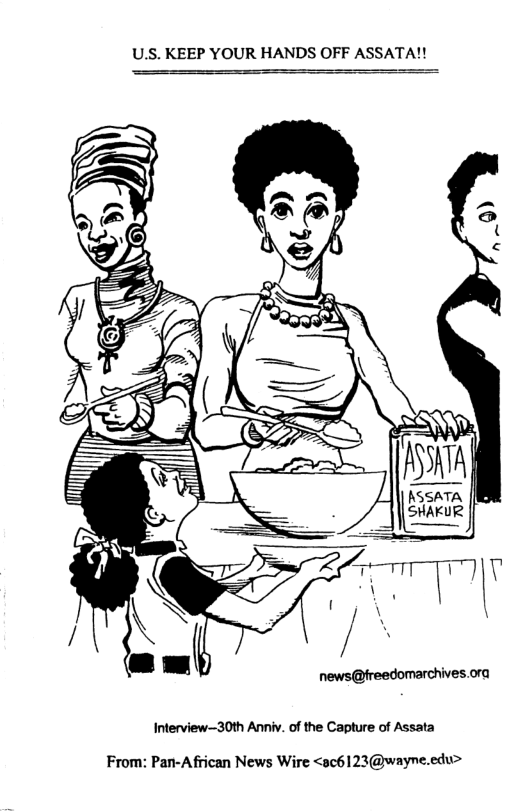
U.S. KEEP YOUR HANDS OFF ASSATA!!  ssATA [  SHAKUR  Interview—30th Anniv. of the Capture of Assata  From: Pan-African News Wire <sc6123@wayne.cdv>
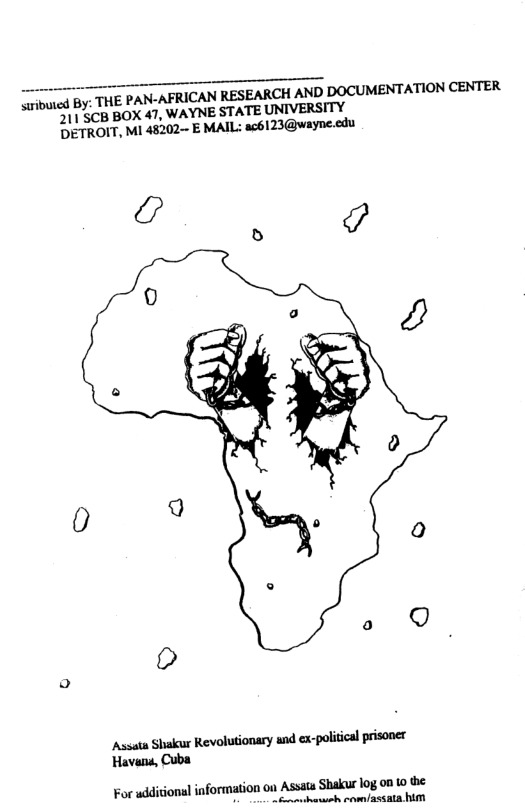
“iomed By. THE PAN-AFRICAN RESEARCH AND. DDOCUMENTATION CENTER %11 SCB BOX 47, WAYNE STATE UNIVERSITY  DETROIT, MI 48202 E MAIL: ac6123@wayne.edu  Assatn Shakur Revolutionary and ex-politcal prisooet Havans, Cuba  For additions information on Assata Shakur log 00 10 the e asweh rom/assata him
ASSATA SHAKUR = The Imerview  What happens to old Black Panthers? Some wind up dead, like Huey P. Newton. Some join the Moonies and the Republican Party, like Eldridge Cleaver. Some, like Mumia Abu Jamal, languish in prison. But a few, like Assata Shakur, have  taken the path of the "maroon,” the runaway slave of old who slipped off the plantation to the free jungle communities known as "palenques.” Two decades ago Shakur was described as "the soul of the Black Liberation Army (BLA)," an underground, paramilitary group that emerged from the rubble of east coast chapters of the Black Panther Party. Among her closest political comrades was Afeni Shakur, Tupac Shakur’s ‘mother. Forced underground in 1971, by charges that were Iater proved false, Assata was accused of being the "bandit queen” of the BLA; the "mother hen who kept them together, kept them moving, kept them shooting.” The BLA’s alleged actions included: assassinating almost ten police officers, kidnapping drug dealers (one of whom turned out to be an FBI agent), and robbing banks from coast to coast. Throughout 1971 and 1972 "Assata sightings” and wild speculation sbout her deeds were a headline mainstay for New York tabloids. Then, on May 2, 1973, Shakur and two friends were pulled over by state trooper. on the New Jersey Turnpike. During the stop, shooting erupted. A trooper and one alleged BLA ‘member were killed, another trooper was slightly hurt and Assata-or Miss Joanne Chesimard, as authorities prefefred to call her-was severely wounded by a blast of police gunfire. Left to die in a paddy wagon, she survived only o be charged for the trooper’s death and sentenced to life in prison. During the next six years (much of it speat in  solitary confinement), Shakur beat a half dozen other indictments. In 1979-afier giving birth in prison, only to  ‘have her daughter taken away in less than a week Assata Shakur managed one of the most impressive jailbreaks of the  era. Afier almost a year in a West Virginia federal prison for women, surrounded by white supremacists from the Aryan
y  Sinamodpfimnns.smkmwuwmmu mhnmmflywingofflmCfimnCmu:\imulCmin New Jersey.  M:hewouofmflydgflmfimmmufiypfim MldinAFmIL‘well-fimcedqdlAb.lockofdfirwn:m  Muwm»fiwmopmflumm’lmlm.flu o\fligfll.anflu:Sh.hn-nd’tbeniM‘-mp- mudwmmk-mmmnnmn TR he parked van. Because only the maximum secirity section ofmwimw-iullthdrhhuuwmwdfle Iolpeeduw.y‘nynmwflkprh’n:hofh HMIMSWSM,MMMMMMG umplmnflwlitwmnwhlu—h\’md- FMMM&AIIMMMHMMMM FBI immediately launched a ‘massive hunt. But Shakur isappeared without a trace. For the next five years -uflwrifishmledinv-inShnkmhldvlfliMNm uMlIIegedBLAudl!wm\nwflldmin.flmM including Tupac’s step-father, Mutula Shalaur. In 1984 word  8 A —ilae nfF the cnast of Florida. The FBI’s most
wanted female fugitive was living in Cuba, workingona &  ‘masters degree in political science, writing her autobiography, and raising her daughter. Cut to 2001. I¢s a stunningly hot summer afternoon in Havana, Cuba the ultimate palenque and I am having strong, black coffee with Assata Shakur who just tumed 54, but looks more like 36. She keeps 1 low profile, security is still a big concer. She’s  finishing her second book. Given how much the Fed’s want this womin locked up, I feel strange being in her house, as  if my presence is a breach of security.  How did you arrive in Cuba? Well, I couldn’t you know, just e Teher md o say "Dear Fidel, I’d like to come to your country." So I had to hoof it-come and wait for the Cubans  10 respond. Luckily, they had some idea who I was, they’d seen some of the briefs and UN petitions from when I was a political prisoner. So they were somewhat familiar with my case and they gave me the status of being a political refugee. That means I am here in exile as a political person. How did you feel when you got here? I was really overwhelmed. Even though I considered myselfa socialist, I had these insanie, silly notions about Cuba. I mean, I grew up in the 19508 when little kids were hiding under their desks, because “the commmunists were coming.” So even though 1 was very supportive of the revolution, | expected everyone to go around in green fatigues looking like Fidel, speaking ina very stercotypical way, “the revolution must continue, Companero. Let us, triumph, Comrade.” When I got here people ‘were just people, doing what they had where I came from. It a country with & strong sense of community. Unlike the USS., folks arentt as isolated. People are really into other people. Also, I didn’t know there were all these black people here and that there was this whole Afro-Cuban culture. My image of Cuba was Che Guevara and Fidel Castro, T hadn’t heard of Antonio Maceo [a hero of the Cuban war of independence] and other Africans who had played a role in Cuban history, The lack of brand names and consumerism also really hit me. You go into a store and there would be a bag of *rice.” It unidermined what [ had taken for granted in the absurd zone where people are like, "Hey, I only eat uncle so and so’s brand of rice.”
So, how were you by the Cuban state? They’ve treated __fl-%quywe rwas “what | expected, | A thought they might be pushy. But they were more interested  in what I wanted to do, in my projects. I told them that the ‘most important things were to unite with my daughter and to write a book. They said, "What do you need to do that?" They were also interested in my vision of the struggle of African people in the United States. I was so impressed by that. Because | grew up-50 to speak-in the movement dealing with white leflists who were very bossy and wanted to tell us  ‘what to do and thought they knew everything. The Cuban attitude was one of solidarity with respect. It was a profound lesson in cooperation.  Did they introduce you o people or guide you around for a while? They gave me a dictionary, an apartment, took me to some historical places, and then | was pretty much on my own. My daughter came down, after prolonged harassment and being denied a passport, and she became my pumber one priority. We discovered Cuban schools together, we did the sixth grade together, explored parks, and the beach. She was taken from you at birth, right? Yesh. It’s not like Cuba.  ‘where you get to breast feed in prison and where they work closely with the family. Some mothers in the U.S. never get 1o see their newborns. I was with my daughter for a week before they sent me back to the prison. That was one of the ‘most difficult periods of my life, that scparation. It’s  only been recently that I’ve been able to talk aboutit. I  had to just block it out, otherwise I think I might have  ‘gone insane. In 1979, when 1 escaped, she was only five years old.  You came to Cuba how soon  Talk about pawd.Todonwmddwuhnfpwple who helped me in jeopardy. Right, I hear you. You’ve talked about adjusting to Cuba, but could you talk a bit sbout adjusting to exile. Well, for me exile means separation from PéodeLiove. Ldin’t and don’t miss the U.S.. ver se.
But black culture, black e American flavor, | definitely miss. mvmfiwnyk,lgammlgjc muileinwnfinsmwip(vimfimhflflmywmymu @Mmmmwmmw-ylwmm. Jogically, was thinking sbout slavery. You know, 8 shvehdlnmmyiplwi the fact that "I may never  ot of problems. I took  while o understand ll that Cibans are up against and fully appreciste al they are rying to do.  get  you’re the only one secing all this pain and inequality. People are saying, "Forget sbout that, just try mpri&h.udywmw.wflvmnlml,”soliving huewum-fimlfimolmy:df,ilwulika"okxy,mm mbflofpwpkm!domgdninjmia"nn Afiime\llmldimvudlnu.Mfimlmlmins mzpolifiu.nbmnsocillim-wmitfudslikemlivein Amnfiyvdfl::vqfllinukwudhy&epwple.vmm
philosophy. I really came tw grips with how much we-Black people in the U.S.-were robbed of. Whether it’s the tambours, the drums, or the dances. Here, they still know rituals preserved from slavery times. It was like finding another piece of myself. I had to find an African name. I’m still looking for picces of that Africa I was tom from.  I’ve found it here in all aspects of the culture. Thereis a tendency to reduce the Africanness of Cuba to the Santaria. Butit’s in the literature, the language, the politics.  worry about  e would come down here from the States and say, "How long do you think the revolution has-two months, three months? Do You think the revolution will survive? You better get out of here.” It was rough. Cubans were complaining every day, which is totally sane. I mean, who wouldn’t? The food situation was really bad, much worse than now. o wransportation, cight-hour blackouts, We would sit in the  dark and wonder, "How much can people take?" I’ve been to prison and lived in the States, so | can take damn near anything. 1 felt I could survive whatever-anything except  U.S. imperialism coming in and taking control. That’s the  one thing | couldn’t survive. Luckily, a lot of Cubans felt  the same way. It took a lot for peopi to pull through,  waiting hours for the bus before work. It wasn’t easy. But ‘ this isn’t a superficial, imposed revolution. This is one of those gut revolutions. One of those blood, sweat and tears revolutions. This-is one of those revolutions where people are like, "We ain’t going back on the plantation, period. We don’t care if you’re Uncle Sam, we don’t care about your guided missiles, about your filthy, dirty CIA maneuvers. We’re this island of 11 million people and we’re gonna live the way we want and if you don’t like it go take  ride.” And we could get stronger with the language. Of course, not everyone feels like that, but enough do.  What about race and racism in Cuba? That’s a big question. The revolution has only been around 30-something years. It  PR
completely gotten rid of racism in that short a time. Socialism is not a magic wand: wave it and everything changes. Can you be more specific about the successes and failures along these lines? I can’t think of any area of the country that is segregated. Another example, the third congress of the Cuban Communist Party was focused on makine. party leadership reflect the actual number of people of color and women in the country. Unfortunately by the time the Fourth Congress rolled around the whole focus had to be on the survival of the revolution. When the Soviet Union and the socialist camp collapsed Cuba lost something like 85 ‘percent of its income. It’s & process but I honestly think  that there’s room for a lot of changes throughout the culture. Some people still talk about "good hair” and "bad hair." Some people think light skin is good, that if you ‘marry a light person you’re advancing the race. There are a lot of contradictions in peoples’ consciousness. There still needs to be de-eurocentrizing of the schools, though Cuba is further along with that than most places in the world. In fairness, I think that race relations in Cuba are 20 times ‘better than they are in the States and I believe the  revolution is committed to eliminating racism completely. | also feel that the special period has changed conditions in Cuba. It’s brought in lots of white tourists, many of whom are racists and expect to be waited on subserviently. Another thing is the ‘’venture corporations which bring their racist ideas and racist corporate practices, for  example not hiring enough blacks. Al of that means the revolution has to be more vigilant than ever in identifying and dealing with racism. A charge one hears, even on the left, is that institutional racism still exists in Cuba. Is  that true? Does one find racist patterns in allocation of ‘housing, work, or the functions of criminal justice? No. I don’t think institutional racism, as such, exists in Cuba.  But at the same titne, people have their personal prejudices.- Obviously these people, with these personai prejudices, must ’work somewhere, and must have some influence on the institutions they work in. But I think it’s superficial to  say racism is institutionalized in Cuba. | believe that  there needs to be a constant campaign to educate people.
racism always has two levels; the level of politicsand |0 policy but also the level of individual consciousness. One  of the things that influences ideas about race in Cuba is  Uhat the revolution happened in 1959, when the world had a very liraited understanding of what racism was. During the 1960s, the world saw the black power movement, ‘which 1, for one, very much benefited from. You know “black is beautiful,” exploring African art, literature, and culture.  That process didn’t really happen in Cuba. Over the years,  {he revolution accomplished so much that most people thought that meant the end of racism. For example, I’d say that more than 90 percent of black people with college degrecs were able t0 do so because of the revolution. They were ina different historical place. The emphasis, for very good reasons, was on black-white unity and the survival of the Tevolution. So it’s only now that people in the universities  ‘are looking into the politics of identity. What do you think  xample, the recent releases of Geronimo Pratt, Johnny  Spain, and Dhoruba Bin Wahad; the continued work of Angela Davis and Bobby Seale and, on a downside, the political wajectory of Eldridge Cleaver and the death of Huey Newton? There have been some victories. And those victorics bhave come about from a lot of hard work. But it took a long time.  think that people in the States should be struggling for the immediate freedom of Mumia Abu Jamal and smnesty for all politcal prisoners. 1 think that the reason these tasks are Targely neglected reflects not only the weakness of the  Jett, but its racism. On the positive side, I think alot of pople are growing and healing. Many of us are for the first time analyzing the way we were wounded. Not just as Alfricans, but as people in the movement who were, and stll ‘e, subjected to terror and surveillance. We’re finally  “ible: to come together and acknowledge that the repression was veal and say, "We need 0 heal.* | have hope for a lot 1 hose peuple who were bumt out or addicted to drugs or
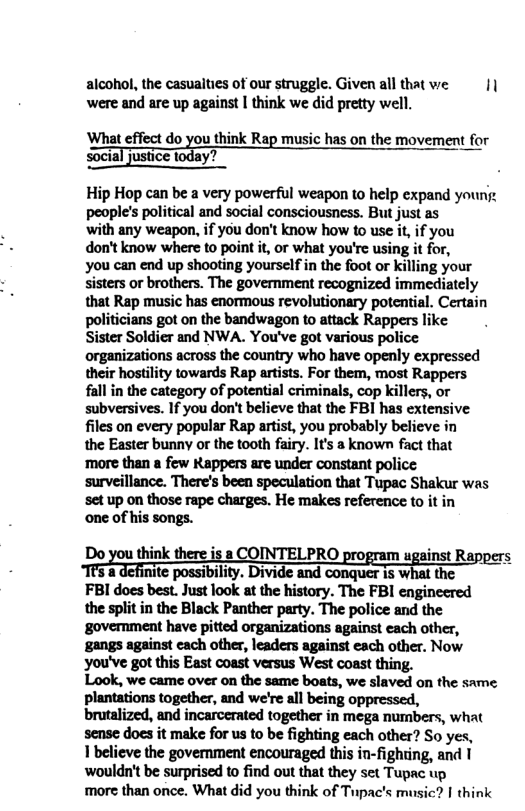
alcohol, the casualties of our struggle. Given all that we n were and are up against | think we did pretty well,  ‘What effect do you think Rap music has on the movement for N o T ———  Hip Hop can be a very powerful weapon 10 help expand youny people’s political and social consciousness. But just as  ‘with any weapon, if you don’t know how to use don’t know where to point it, or what you’re usi you can end up shooting yourself in the foot or killing your sisters or brothers. The government recognized immediately that Rap music has enormous revolutionary potential. Certain politicians got on the bandwagon to attack Rappers like  Sister Soldier and NWA. You’ve got various police organizations across the country who have openly expressed their hostility towards Rap artists. For them, most Rappers fall in the category of potential criminals, cop killers, or subversives. If you don’t believe that the FBI has extensive files on every popular Rap artist, you probably believe in  the Easter bunny or the tooth fairy. It’s a known fact that ‘more than a few Rappers are under constant police surveillance. There’s been speculation that Tupac Shakur was set up on those rape charges. He makes reference to it in  one of his songs.  Do you think there is a COINTELPRO ugainst Rappers 1!’% te possil Divide and eonqmgmu ‘What the  FBI does best. Just look at the history. The FBI engineered the split in the Black Panther party. The police and the government have pitted organizations against each other, ‘gangs against each other, leaders against each other. Now ‘you’ve got this East coast versus West coast thing.  Look, we came over on the same boats, we slaved on the same plantations together, and we’re all being oppressed,  brutalized, and incarcerated together in mega numbers, what sense does it make for us to be fighting each other? So yes, Tbelieve the government encouraged this in-fighting, and | wouldn’t be surprised to find out that they set Tupac up  more than once. What did you think of Tupac’s music? I think
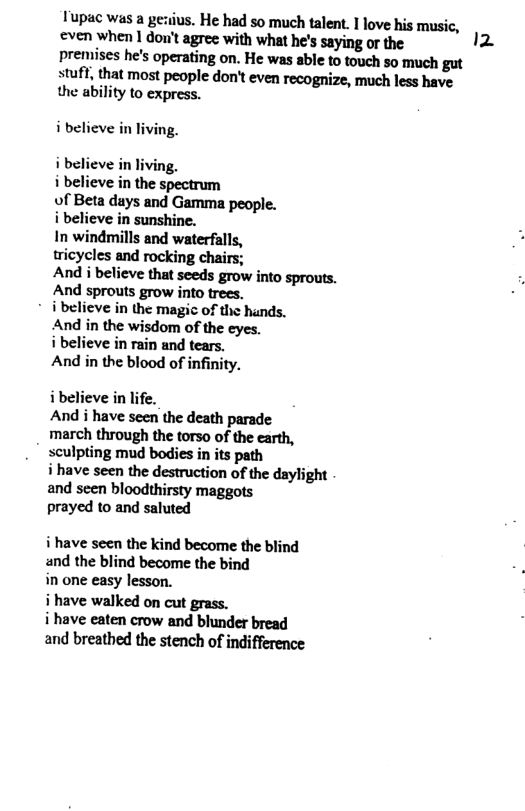
1upuc was a geriius. He had so much talent. I love his music, ven when | don’t agree with what he’s saying or the =3 premises he’s operating on. He was sble to touch so much gut stuff, that most people don’t even recognize, much less have  the ability to express.  i believe in living.  i believe in living. i believe in the spectrum of Beta days and Gamma people. i believe in sunshine. In windmills and waterfalls, tricycles and rocking chairs; And i believe that seeds grow into sprouts. And sprouts grow into trees. * i believe in the magic of the hands. And in the wisdom of the eyes. i believe in rain and tears. And in the blood of infinity.  i believe in life. And i have seen the death parade  march through the torso of the earth, sculpting mud bodies in its path  i have seen the destruction of the daylight and seen bloodthirsty maggots  prayed to and saluted  i have seen the kind become the blind and the blind become the bind  in one easy lesson.  i have walked on cut grass.  i have eaten crow and blunder bread and breathed the stench of indifference
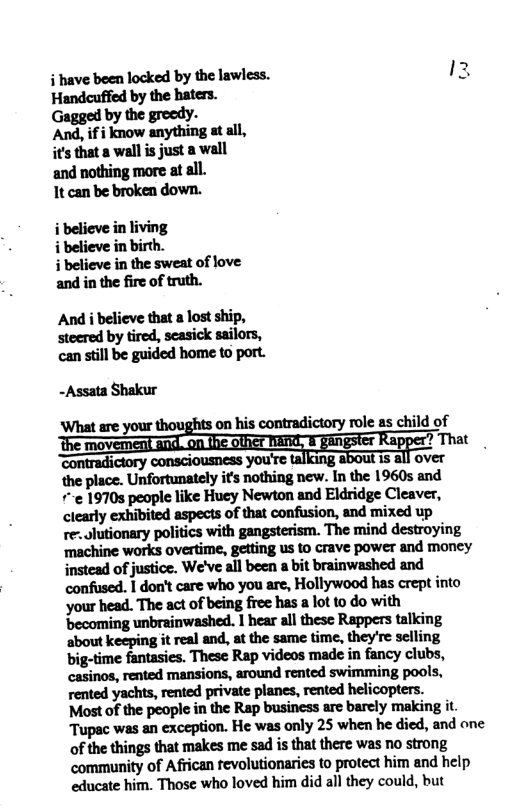
i have been locked by the lawless. 12 Handcuffed by the haters.  Gagged by the greedy.  And, if i know anything at all,  it’s that a wall is just a wall  and nothing more at all.  It can be broken down.  i believe in living  i believe in birth.  i believe in the sweat of love and in the fire of truth.  And i believe that a lost ship, steered by tired, seasick sailors, can still be guided home to port.  contradictory  Mmunfnmmynfimnqm.lnlhc 1960s and  ¢ 1970s people like Huey Newton and Eldridge Cleaver, clearly exhibited aspects of that confusion, and mixed up re-olutionary politics with gangsterism. The mind destroying ‘machine works overtime, getting us to crave power and money instead of justice. We’ve all been a bit brainwashed and confused. T don’t care who you are, Hollywood has crept into mhfl.mmo‘bfin‘fi%mflmmdowilh ‘ecoming unbrainwashed. I hear all these Rappers talking about keeping it real and, at the same time, they’re sclling bigvmfinmifl.mhpvidfl-mminfumydubs, casinos, rented mansions, around rented swimming pools, rented yachts, rented private planes, rented helicopters.  Most of the people in the Rap business are barely making it Tupac was an exception. He was only 25 when he died, and one of the things that makes me sad is that there was no strong community of African fevolutionaries to protect him and help educate him. Those who loved him did all they could, but
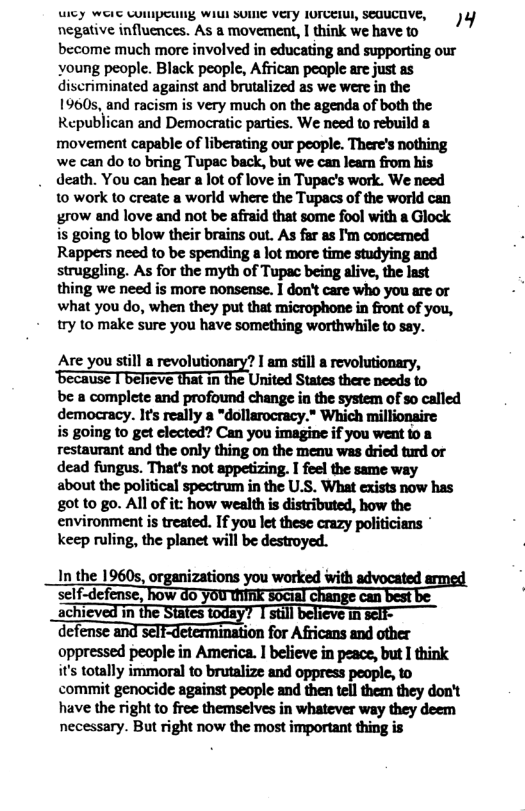
UIGy WEIT COIPEUIE WILI SULIC VETY IOTCEIUI, SEQUCOVE, ) negative influences. As a movement, I think we have to become much more involved in educating and supporting our voung people. Black people, African peaple are just as discriminated against and brutalized as we were in the  1960s, and racism is very much on the agenda of both the Republican and Democratic parties. We need to rebuild a movement capable of liberating our people. There’s nothing we can do o bring Tupac back, but we can learn from his death. You can hear a lot of love in Tupac’s work. We need 10 work to create a world where the Tupacs of the world can grow and love and not be afraid that some fool with a Glock is going to blow their brains out. As far as I’m concerned Rappers need to be spending a lot more time studying and struggling. As for the myth of Tupac being alive, the last thing we need is more nonsense. I don’t care who you are or what you do, when they put that microphone in front of you, try to make sure you have something worthwhile to say.  Are you still a revolutionary? | am still a revolutionary, Because Theleve i the :Jfimsmmmm be a complete and profound change in the system of so called democracy. It’s really a "dollarocracy.” Which millionaire  is going to get clected? Can you imagine if you went to a restaurant and the only thing on the menu was dried turd or dead fungus. That’s not appetizing. I feel the same way about the political spectrum in the U.S. What exists now has got to go. All of it: how wealth s distributed, how the environment is treated. If you let these crazy politicians keep ruling, the planet will be destroyed.  In the 1960s, organizations you worked with advocated i deense hour o T SoonT Shangs b achid in n  defense ion for Africans and other oppressed people in America. I believe in peace, but I think it’s totally immoral to brutalize and oppress people, to  commit genocide against people and then tel them they don’t have the right to free themselves in whatever way they deem necessary. But right now the most important thing is
consciousness raising. Making social change and social jufiumupenphhnembemrewmim-mm bwd.mdendmddemmnmmmodywmd mbmm\dclu.miln.flwemw.m.m nmhdsofl‘)n,nudiluwnwwimhm, mndiwmnexlmmemuuying.’\‘l«hsnfmewld uniu,’m’lww(‘l.Wenfidmunllmlfl’vemmunf nmmmmiummoldvlylofmmxiom arentt going to work. The litde Leninist study groups won’t dflhWemdwmfidm.ndimhlmnfi.Wedm need to work on the basics of rebuilding communify. How are you going to organize or liberate your community if you don’lhlv:m’!lliwin(hb!.ww:wu&mviu hazmdlmid(o(mmmwuwnmynfw mmEveynfimmwiei-fqrudmmWe mpmmvepmna.pmndmuwinm wnf\doiflimfimlndffll’.lwmuinmsum pwpummqfifidm@nk:mwmflmflnm mmmwwummmwmso weudmmbll’ldllmfiofemumi’lyudflmm knocking on doors apd reconnecting.  FREE ALL POLITICAL PRISONERS! FREE MUMIA ABU-JAMAL!  FREE ALL OPPRESSED PEOPLE! WEW!U,BEF&EEIWEWILLBEFREE !  IN THE SPIRIT OF MARTHA PITTS LET US CARRY THIS STRUGGLE ON!  Assata Shakur Revolutionary and ex-political prisoner Havana, Cuba  For additional information on Assata Shakur 10g on 10 the following URL: htp://www.afrocubaweb.com/assata htm  © 1998-2003.thetalkingdrum.com. Al Rights Reserved.
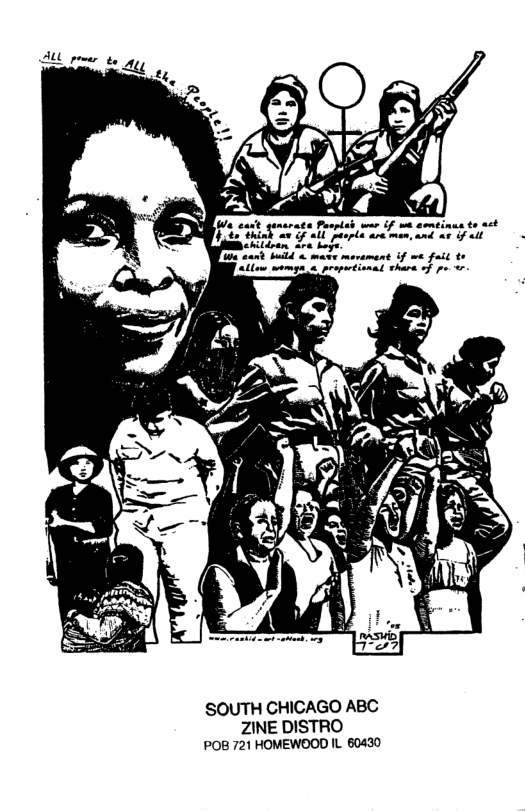
SOUTH CHICAGO ABC  ZINE DISTRO POB 721 HOMEWOOD IL 60430
U.S. KEEP YOUR HANDS OFF ASSATA!!

ssATA [

SHAKUR

Interview—30th Anniv. of the Capture of Assata

From: Pan-African News Wire <sc6123@wayne.cdv>
“iomed By. THE PAN-AFRICAN RESEARCH AND. DDOCUMENTATION CENTER
%11 SCB BOX 47, WAYNE STATE UNIVERSITY

DETROIT, MI 48202 E MAIL: ac6123@wayne.edu

Assatn Shakur Revolutionary and ex-politcal prisooet
Havans, Cuba

For additions information on Assata Shakur log 00 10 the
e asweh rom/assata him
ASSATA SHAKUR =
The Imerview

What happens to old Black Panthers? Some wind up dead, like
Huey P. Newton. Some join the Moonies and the Republican
Party, like Eldridge Cleaver. Some, like Mumia Abu Jamal,
languish in prison. But a few, like Assata Shakur, have

taken the path of the "maroon,” the runaway slave of old who
slipped off the plantation to the free jungle communities
known as "palenques.” Two decades ago Shakur was described
as "the soul of the Black Liberation Army (BLA)," an
underground, paramilitary group that emerged from the rubble
of east coast chapters of the Black Panther Party. Among her
closest political comrades was Afeni Shakur, Tupac Shakur's
‘mother. Forced underground in 1971, by charges that were
Iater proved false, Assata was accused of being the "bandit
queen” of the BLA; the "mother hen who kept them together,
kept them moving, kept them shooting.” The BLA's alleged
actions included: assassinating almost ten police officers,
kidnapping drug dealers (one of whom turned out to be an FBI
agent), and robbing banks from coast to coast. Throughout
1971 and 1972 "Assata sightings” and wild speculation sbout
her deeds were a headline mainstay for New York tabloids.
Then, on May 2, 1973, Shakur and two friends were pulled
over by state trooper. on the New Jersey Turnpike. During
the stop, shooting erupted. A trooper and one alleged BLA
‘member were killed, another trooper was slightly hurt and
Assata-or Miss Joanne Chesimard, as authorities prefefred to
call her-was severely wounded by a blast of police gunfire.
Left to die in a paddy wagon, she survived only o be
charged for the trooper’s death and sentenced to life in
prison. During the next six years (much of it speat in

solitary confinement), Shakur beat a half dozen other
indictments. In 1979-afier giving birth in prison, only to

‘have her daughter taken away in less than a week Assata
Shakur managed one of the most impressive jailbreaks of the

era. Afier almost a year in a West Virginia federal prison
for women, surrounded by white supremacists from the Aryan
y

Sinamodpfimnns.smkmwuwmmu
mhnmmflywingofflmCfimnCmu:\imulCmin
New Jersey.

M:hewouofmflydgflmfimmmufiypfim
MldinAFmIL‘well-fimcedqdlAb.lockofdfirwn:m

Muwm»fiwmopmflumm'lmlm.flu
o\fligfll.anflu:Sh.hn-nd'tbeniM‘-mp-
mudwmmk-mmmnnmn
TR he parked van. Because only the maximum secirity section
ofmwimw-iullthdrhhuuwmwdfle
Iolpeeduw.y‘nynmwflkprh'n:hofh
HMIMSWSM,MMMMMMG
umplmnflwlitwmnwhlu—h\'md-
FMMM&AIIMMMHMMMM
FBI immediately launched a ‘massive hunt. But Shakur
isappeared without a trace. For the next five years
-uflwrifishmledinv-inShnkmhldvlfliMNm
uMlIIegedBLAudl!wm\nwflldmin.flmM
including Tupac's step-father, Mutula Shalaur. In 1984 word

8 A —ilae nfF the cnast of Florida. The FBI's most

wanted female fugitive was living in Cuba, workingona &

‘masters degree in political science, writing her
autobiography, and raising her daughter. Cut to 2001. I¢s a
stunningly hot summer afternoon in Havana, Cuba the ultimate
palenque and I am having strong, black coffee with Assata
Shakur who just tumed 54, but looks more like 36. She keeps
1 low profile, security is still a big concer. She's

finishing her second book. Given how much the Fed's want
this womin locked up, I feel strange being in her house, as

if my presence is a breach of security.

How did you arrive in Cuba? Well, I couldn't you know, just
e Teher md o say "Dear Fidel, I'd like to come to your
country." So I had to hoof it-come and wait for the Cubans

10 respond. Luckily, they had some idea who I was, they'd
seen some of the briefs and UN petitions from when I was a
political prisoner. So they were somewhat familiar with my
case and they gave me the status of being a political
refugee. That means I am here in exile as a political
person. How did you feel when you got here? I was really
overwhelmed. Even though I considered myselfa socialist, I
had these insanie, silly notions about Cuba. I mean, I grew
up in the 19508 when little kids were hiding under their
desks, because “the commmunists were coming.” So even though
1 was very supportive of the revolution, | expected everyone
to go around in green fatigues looking like Fidel, speaking
ina very stercotypical way, “the revolution must continue,
Companero. Let us, triumph, Comrade.” When I got here people
‘were just people, doing what they had where I came from.
It a country with & strong sense of community. Unlike the
USS., folks arentt as isolated. People are really into other
people. Also, I didn't know there were all these black
people here and that there was this whole Afro-Cuban
culture. My image of Cuba was Che Guevara and Fidel Castro,
T hadn't heard of Antonio Maceo [a hero of the Cuban war of
independence] and other Africans who had played a role in
Cuban history, The lack of brand names and consumerism also
really hit me. You go into a store and there would be a bag
of *rice.” It unidermined what [ had taken for granted in the
absurd zone where people are like, "Hey, I only eat uncle so
and so's brand of rice.”
So, how were you by the Cuban state? They've treated
__fl-%quywe rwas “what | expected, | A
thought they might be pushy. But they were more interested

in what I wanted to do, in my projects. I told them that the
‘most important things were to unite with my daughter and to
write a book. They said, "What do you need to do that?" They
were also interested in my vision of the struggle of African
people in the United States. I was so impressed by that.
Because | grew up-50 to speak-in the movement dealing with
white leflists who were very bossy and wanted to tell us

‘what to do and thought they knew everything. The Cuban
attitude was one of solidarity with respect. It was a
profound lesson in cooperation.

Did they introduce you o people or guide you around for a
while? They gave me a dictionary, an apartment, took me to
some historical places, and then | was pretty much on my
own. My daughter came down, after prolonged harassment and
being denied a passport, and she became my pumber one
priority. We discovered Cuban schools together, we did the
sixth grade together, explored parks, and the beach. She was
taken from you at birth, right? Yesh. It's not like Cuba.

‘where you get to breast feed in prison and where they work
closely with the family. Some mothers in the U.S. never get
1o see their newborns. I was with my daughter for a week
before they sent me back to the prison. That was one of the
‘most difficult periods of my life, that scparation. It's

only been recently that I've been able to talk aboutit. I

had to just block it out, otherwise I think I might have

‘gone insane. In 1979, when 1 escaped, she was only five
years old.

You came to Cuba how soon

Talk about pawd.Todonwmddwuhnfpwple
who helped me in jeopardy. Right, I hear you. You've talked
about adjusting to Cuba, but could you talk a bit sbout
adjusting to exile. Well, for me exile means separation from
PéodeLiove. Ldin't and don't miss the U.S.. ver se.
But black culture, black e
American flavor, | definitely miss.
mvmfiwnyk,lgammlgjc
muileinwnfinsmwip(vimfimhflflmywmymu
@Mmmmwmmw-ylwmm.
Jogically, was thinking sbout slavery. You know, 8
shvehdlnmmyiplwi the fact that "I may never

ot of problems. I took while o understand ll that
Cibans are up against and fully appreciste al they are
rying to do.

get

you're the only one secing all this pain and
inequality. People are saying, "Forget sbout that, just try
mpri&h.udywmw.wflvmnlml,”soliving
huewum-fimlfimolmy:df,ilwulika"okxy,mm
mbflofpwpkm!domgdninjmia"nn
Afiime\llmldimvudlnu.Mfimlmlmins
mzpolifiu.nbmnsocillim-wmitfudslikemlivein
Amnfiyvdfl::vqfllinukwudhy&epwple.vmm
philosophy. I really came tw grips with how much we-Black
people in the U.S.-were robbed of. Whether it's the
tambours, the drums, or the dances. Here, they still know
rituals preserved from slavery times. It was like finding
another piece of myself. I had to find an African name. I'm
still looking for picces of that Africa I was tom from.

I've found it here in all aspects of the culture. Thereis a
tendency to reduce the Africanness of Cuba to the Santaria.
Butit's in the literature, the language, the politics.

worry about

e
would come down here from the States and say, "How long do
you think the revolution has-two months, three months? Do
You think the revolution will survive? You better get out of
here.” It was rough. Cubans were complaining every day,
which is totally sane. I mean, who wouldn't? The food
situation was really bad, much worse than now. o
wransportation, cight-hour blackouts, We would sit in the

dark and wonder, "How much can people take?" I've been to
prison and lived in the States, so | can take damn near
anything. 1 felt I could survive whatever-anything except

U.S. imperialism coming in and taking control. That's the

one thing | couldn't survive. Luckily, a lot of Cubans felt

the same way. It took a lot for peopi to pull through,

waiting hours for the bus before work. It wasn't easy. But ‘
this isn't a superficial, imposed revolution. This is one of
those gut revolutions. One of those blood, sweat and tears
revolutions. This-is one of those revolutions where people
are like, "We ain't going back on the plantation, period. We
don't care if you're Uncle Sam, we don't care about your
guided missiles, about your filthy, dirty CIA maneuvers.
We're this island of 11 million people and we're gonna live
the way we want and if you don't like it go take ride.”
And we could get stronger with the language. Of course, not
everyone feels like that, but enough do.

What about race and racism in Cuba? That's a big question.
The revolution has only been around 30-something years. It

PR

completely gotten rid of racism in that short a time.
Socialism is not a magic wand: wave it and everything
changes. Can you be more specific about the successes and
failures along these lines? I can't think of any area of the
country that is segregated. Another example, the third
congress of the Cuban Communist Party was focused on makine.
party leadership reflect the actual number of people of
color and women in the country. Unfortunately by the time
the Fourth Congress rolled around the whole focus had to be
on the survival of the revolution. When the Soviet Union and
the socialist camp collapsed Cuba lost something like 85
‘percent of its income. It's & process but I honestly think

that there's room for a lot of changes throughout the
culture. Some people still talk about "good hair” and "bad
hair." Some people think light skin is good, that if you
‘marry a light person you're advancing the race. There are a
lot of contradictions in peoples' consciousness. There still
needs to be de-eurocentrizing of the schools, though Cuba is
further along with that than most places in the world. In
fairness, I think that race relations in Cuba are 20 times
‘better than they are in the States and I believe the

revolution is committed to eliminating racism completely. |
also feel that the special period has changed conditions in
Cuba. It's brought in lots of white tourists, many of whom
are racists and expect to be waited on subserviently.
Another thing is the ‘'venture corporations which bring
their racist ideas and racist corporate practices, for

example not hiring enough blacks. Al of that means the
revolution has to be more vigilant than ever in identifying
and dealing with racism. A charge one hears, even on the
left, is that institutional racism still exists in Cuba. Is

that true? Does one find racist patterns in allocation of
‘housing, work, or the functions of criminal justice? No. I
don't think institutional racism, as such, exists in Cuba.

But at the same titne, people have their personal prejudices.-
Obviously these people, with these personai prejudices, must
'work somewhere, and must have some influence on the
institutions they work in. But I think it's superficial to

say racism is institutionalized in Cuba. | believe that

there needs to be a constant campaign to educate people.

racism always has two levels; the level of politicsand |0
policy but also the level of individual consciousness. One

of the things that influences ideas about race in Cuba is

Uhat the revolution happened in 1959, when the world had a
very liraited understanding of what racism was. During the
1960s, the world saw the black power movement, ‘which 1, for
one, very much benefited from. You know “black is
beautiful,” exploring African art, literature, and culture.

That process didn't really happen in Cuba. Over the years,

{he revolution accomplished so much that most people thought
that meant the end of racism. For example, I'd say that more
than 90 percent of black people with college degrecs were
able t0 do so because of the revolution. They were ina
different historical place. The emphasis, for very good
reasons, was on black-white unity and the survival of the
Tevolution. So it's only now that people in the universities

‘are looking into the politics of identity. What do you think

xample, the recent releases of Geronimo Pratt, Johnny

Spain, and Dhoruba Bin Wahad; the continued work of Angela
Davis and Bobby Seale and, on a downside, the political
wajectory of Eldridge Cleaver and the death of Huey Newton?
There have been some victories. And those victorics bhave
come about from a lot of hard work. But it took a long time.

think that people in the States should be struggling for the
immediate freedom of Mumia Abu Jamal and smnesty for all
politcal prisoners. 1 think that the reason these tasks are
Targely neglected reflects not only the weakness of the

Jett, but its racism. On the positive side, I think alot of
pople are growing and healing. Many of us are for the first
time analyzing the way we were wounded. Not just as
Alfricans, but as people in the movement who were, and stll
‘e, subjected to terror and surveillance. We're finally

“ible: to come together and acknowledge that the repression
was veal and say, "We need 0 heal.* | have hope for a lot
1 hose peuple who were bumt out or addicted to drugs or
alcohol, the casualties of our struggle. Given all that we n
were and are up against | think we did pretty well,

‘What effect do you think Rap music has on the movement for
N o T ———

Hip Hop can be a very powerful weapon 10 help expand youny
people’s political and social consciousness. But just as

‘with any weapon, if you don't know how to use
don't know where to point it, or what you're usi
you can end up shooting yourself in the foot or killing your
sisters or brothers. The government recognized immediately
that Rap music has enormous revolutionary potential. Certain
politicians got on the bandwagon to attack Rappers like

Sister Soldier and NWA. You've got various police
organizations across the country who have openly expressed
their hostility towards Rap artists. For them, most Rappers
fall in the category of potential criminals, cop killers, or
subversives. If you don't believe that the FBI has extensive
files on every popular Rap artist, you probably believe in

the Easter bunny or the tooth fairy. It's a known fact that
‘more than a few Rappers are under constant police
surveillance. There's been speculation that Tupac Shakur was
set up on those rape charges. He makes reference to it in

one of his songs.

Do you think there is a COINTELPRO ugainst Rappers
1!'% te possil Divide and eonqmgmu ‘What the

FBI does best. Just look at the history. The FBI engineered
the split in the Black Panther party. The police and the
government have pitted organizations against each other,
‘gangs against each other, leaders against each other. Now
‘you've got this East coast versus West coast thing.

Look, we came over on the same boats, we slaved on the same
plantations together, and we're all being oppressed,

brutalized, and incarcerated together in mega numbers, what
sense does it make for us to be fighting each other? So yes,
Tbelieve the government encouraged this in-fighting, and |
wouldn't be surprised to find out that they set Tupac up

more than once. What did you think of Tupac's music? I think

1upuc was a geriius. He had so much talent. I love his music,
ven when | don't agree with what he's saying or the =3
premises he's operating on. He was sble to touch so much gut
stuff, that most people don't even recognize, much less have

the ability to express.

i believe in living.

i believe in living.
i believe in the spectrum
of Beta days and Gamma people.
i believe in sunshine.
In windmills and waterfalls,
tricycles and rocking chairs;
And i believe that seeds grow into sprouts.
And sprouts grow into trees.
* i believe in the magic of the hands.
And in the wisdom of the eyes.
i believe in rain and tears.
And in the blood of infinity.

i believe in life.
And i have seen the death parade

march through the torso of the earth,
sculpting mud bodies in its path

i have seen the destruction of the daylight
and seen bloodthirsty maggots

prayed to and saluted

i have seen the kind become the blind
and the blind become the bind

in one easy lesson.

i have walked on cut grass.

i have eaten crow and blunder bread
and breathed the stench of indifference
i have been locked by the lawless. 12
Handcuffed by the haters.

Gagged by the greedy.

And, if i know anything at all,

it's that a wall is just a wall

and nothing more at all.

It can be broken down.

i believe in living

i believe in birth.

i believe in the sweat of love
and in the fire of truth.

And i believe that a lost ship,
steered by tired, seasick sailors,
can still be guided home to port.

contradictory

Mmunfnmmynfimnqm.lnlhc 1960s and

¢ 1970s people like Huey Newton and Eldridge Cleaver,
clearly exhibited aspects of that confusion, and mixed up
re-olutionary politics with gangsterism. The mind destroying
‘machine works overtime, getting us to crave power and money
instead of justice. We've all been a bit brainwashed and
confused. T don't care who you are, Hollywood has crept into
mhfl.mmo‘bfin‘fi%mflmmdowilh
‘ecoming unbrainwashed. I hear all these Rappers talking
about keeping it real and, at the same time, they're sclling
bigvmfinmifl.mhpvidfl-mminfumydubs,
casinos, rented mansions, around rented swimming pools,
rented yachts, rented private planes, rented helicopters.

Most of the people in the Rap business are barely making it
Tupac was an exception. He was only 25 when he died, and one
of the things that makes me sad is that there was no strong
community of African fevolutionaries to protect him and help
educate him. Those who loved him did all they could, but
UIGy WEIT COIPEUIE WILI SULIC VETY IOTCEIUI, SEQUCOVE, )
negative influences. As a movement, I think we have to
become much more involved in educating and supporting our
voung people. Black people, African peaple are just as
discriminated against and brutalized as we were in the

1960s, and racism is very much on the agenda of both the
Republican and Democratic parties. We need to rebuild a
movement capable of liberating our people. There's nothing
we can do o bring Tupac back, but we can learn from his
death. You can hear a lot of love in Tupac's work. We need
10 work to create a world where the Tupacs of the world can
grow and love and not be afraid that some fool with a Glock
is going to blow their brains out. As far as I'm concerned
Rappers need to be spending a lot more time studying and
struggling. As for the myth of Tupac being alive, the last
thing we need is more nonsense. I don't care who you are or
what you do, when they put that microphone in front of you,
try to make sure you have something worthwhile to say.

Are you still a revolutionary? | am still a revolutionary,
Because Theleve i the :Jfimsmmmm
be a complete and profound change in the system of so called
democracy. It's really a "dollarocracy.” Which millionaire

is going to get clected? Can you imagine if you went to a
restaurant and the only thing on the menu was dried turd or
dead fungus. That's not appetizing. I feel the same way
about the political spectrum in the U.S. What exists now has
got to go. All of it: how wealth s distributed, how the
environment is treated. If you let these crazy politicians
keep ruling, the planet will be destroyed.

In the 1960s, organizations you worked with advocated
i deense hour o T SoonT Shangs b
achid in n

defense ion for Africans and other
oppressed people in America. I believe in peace, but I think
it's totally immoral to brutalize and oppress people, to

commit genocide against people and then tel them they don't
have the right to free themselves in whatever way they deem
necessary. But right now the most important thing is
consciousness raising. Making social change and social
jufiumupenphhnembemrewmim-mm
bwd.mdendmddemmnmmmodywmd
mbmm\dclu.miln.flwemw.m.m
nmhdsofl‘)n,nudiluwnwwimhm,
mndiwmnexlmmemuuying.'\‘l«hsnfmewld
uniu,'m'lww(‘l.Wenfidmunllmlfl'vemmunf
nmmmmiummoldvlylofmmxiom
arentt going to work. The litde Leninist study groups won't
dflhWemdwmfidm.ndimhlmnfi.Wedm
need to work on the basics of rebuilding communify. How are
you going to organize or liberate your community if you
don'lhlv:m'!lliwin(hb!.ww:wu&mviu
hazmdlmid(o(mmmwuwnmynfw
mmEveynfimmwiei-fqrudmmWe
mpmmvepmna.pmndmuwinm
wnf\doiflimfimlndffll’.lwmuinmsum
pwpummqfifidm@nk:mwmflmflnm
mmmwwummmwmso
weudmmbll'ldllmfiofemumi’lyudflmm
knocking on doors apd reconnecting.

FREE ALL POLITICAL PRISONERS!
FREE MUMIA ABU-JAMAL!

FREE ALL OPPRESSED PEOPLE!
WEW!U,BEF&EEIWEWILLBEFREE !

IN THE SPIRIT OF MARTHA PITTS
LET US CARRY THIS STRUGGLE ON!

Assata Shakur Revolutionary and ex-political prisoner
Havana, Cuba

For additional information on Assata Shakur 10g on 10 the
following URL: htp://www.afrocubaweb.com/assata htm

© 1998-2003.thetalkingdrum.com.
Al Rights Reserved.
SOUTH CHICAGO ABC

ZINE DISTRO
POB 721 HOMEWOOD IL 60430